
Imagine wind turbine blades that change shape to achieve the most efficiency in varying wind speeds, or airplane wings that bend and alter their own form without hydraulic rudders and ailerons. These are two potential uses for a carbon fibre material unveiled by researchers from KTH Royal Institute of Technology in Sweden.
The researchers demonstrated that a new solid-state carbon fibre composite is capable of changing form with the help of electronic impulses. They explained this research in a proof-of-concept study published recently by Proceedings of the National Academy of Sciences of the United States of America (PNAS).
Co-author Daniel Zenkert said the material exhibits all the advantageous properties of shape-morphing material – without the drawbacks that have prevented other development work from taking flight, such as weight and insufficient mechanical stiffness.
According to Zenkert, state-of-the-art morphing technologies, which can be used in robotics and satellite booms, rely on systems of heavy mechanical motors, hydraulic and pneumatic pumps, or solenoids to create shape changes. These mechanically complicated systems add what is known as “parasitic weight” and are costly to maintain.
Zenkert explained that one way to reduce the mechanical complexity is to use solid-state morphing materials. “We have developed an entirely new concept,” he said. “It’s lightweight, stiffer than aluminum and the material changes shape using electric current.” The material can produce large deformations and holding them with no additional power, albeit at low rates, he says.
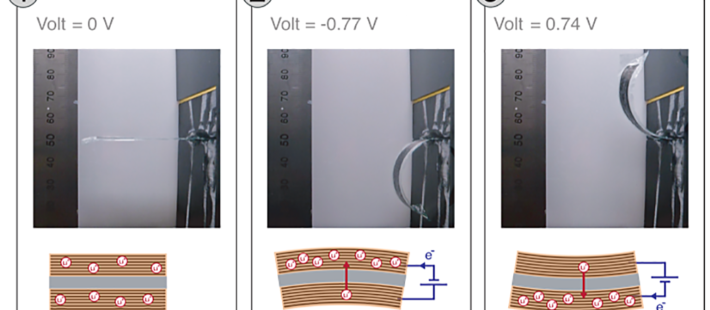
The composite consists of three layers – two of which are commercial carbon fibre doped with lithium-ions on each side of a thin separator. When the carbon fibre layers each have an equal distribution of ions, the material is straight. As electric current is added, the lithium ions migrate from one side to the other causing the material to bend. Reversing the current enables the material to return to a state of equilibrium and regain its previous, unbent form.
“We have for some time worked with structural batteries, such as carbon fiber composites that also store energy like a lithium-ion battery,” Zenkert said. “Now we have further developed the work. We expect it lead to completely new concepts for materials that change shape only by electrical control, materials that are also light and rigid.”
The researchers are now moving forward with other lightweight and structural materials that use less energy during use, with the aim of resource efficiency and sustainability.