

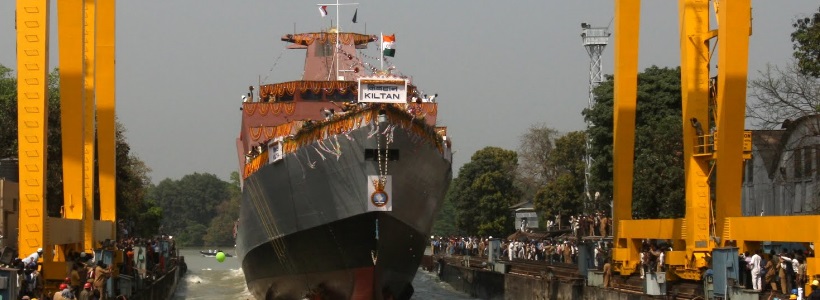
The Navy is building two Anti-Submarine Warfare Corvettes using carbon fibre composite material from Sweden for the first time as it goes beyond using steel for warships.
Warships are traditionally made using stainless steel but the new carbon fibre composite superstructure, imported from Swedish shipyard Kockums, not only makes the warship lighter but also makes it difficult for for the enemy to spot.
Being built by defence PSU Garden Reach Shipbuilders & Engineers Ltd (GRSE) in Kolkata, INS Kiltan and INS Kavaratti are named after islands in the Lakshadweep archipelago. The Kamorta-class corvettes would be delivered to the Navy within 2017.
“These are the first ships where such a technology is being used in India. Stealth is the most important feature of composite material as it is less susceptible to detection unlike steel,” Commodore Ratnakar Ghosh, Director (shipbuilding), GRSE, told PTI.
The ship’s superstructure is made of composite material while the remaining part including hull uses steel.
The new technology with extremely low radar cross-section has been pioneered by Swedish Navy which uses Visby-class corvettes, made entirely of composites. Other nations have used fiberglass reinforced plastic (FBR) for similar stealth features.
Divided into smaller blocks, parts of the composite superstructure came from the Swedish shipyard and were assembled a nd integrated with the main hull under supervision of Swedish experts in Kolkata.
“We have reduced the weight of the superstructure by about 100 tonnes using this technology. This will allow the Navy to add more payload weapons. It will also be an added advantage when the ship has to go for modernisation after a few years,” the official said.
Composites are also anti-corrosives, a feature needed to guard against corrosion by sea water.
To make it fire resistant, parts of the superstructure have been super-insulated. However, the cost of this new technology is higher as compared to steel.”The weight of the superstructure should be around 30 per cent less. The cost is higher but that is offset against the long term advantages it offers,” Ghosh said.
GRSE’s Chairman and Managing Director Rear Admiral (Retd) A K Verma said in future they would tie-up with some India- based contractors who can supply th m such composites.
“We have to look for people who can make such type of composites in India as per our specifications. We are training our people also,” he said.
Aimed at enhancing the Navy’s underwater warfare capabilities, the warships will be fitted with indigenous state-of-the-art weapons and sensors. With an overall length of about 110 metres, the ships can cut through the sea at a very high speed of 25 knots.