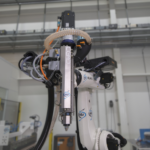


At the end of October, Rolls-Royce announced that it is growing its presence in Southern California, with a $30 million expansion into a new 62,000 square foot facility that will be dedicated to research and development of ceramic matrix composite (CMC) materials and processes for use in next generation aircraft engine components.
Rolls-Royce held a dedication ceremony with federal, state and local officials, customers and employees at the new facility. Rolls-Royce purchased Hyper-Therm High-Temperature Composites, a privately held company based in in Huntington Beach, in May 2013 and continues to grow and invest with this new “CMC technology hub” located in in Cypress, Calif.
Rolls-Royce President and CEO of North America, Marion Blakey said this expansion will develop novel solutions to improve performance of future aircraft engines. “The development of lighter, stronger, composite fiber components is just part of our commitment to continuously improve the performance of our products by focusing on lowering fuel consumption, emissions and noise. The team here in Cypress will be dedicated to seeing the commercial application of these technologies that will soon be adopted into advanced manufacturing production methods for gas turbine components.”
Ceramic matrix composites (CMCs) offer multiple advantages for a range of high-tech industries such as aerospace and other applications with demanding thermal and mechanical requirements. CMCs deliver the high temperature capability of ceramics with the strength and reliability that is required for gas turbine engine applications, but weigh less than current alloys. CMC components help save on fuel costs since they are lighter weight and require less cooling over traditional nickel-based components.
“The turbine sits at the heart of the engine. I am very excited about several technologies we are developing across Rolls-Royce that will contribute to a significant reduction in fuel consumption. Our HTC team in California is part of a global team working on high temperature composites.” said Andy Greasley, Executive Vice President – Turbines, Civil Aerospace. “This dedication ceremony represents the completion of another major milestone and the creation of a state-of-the art facility specifically purposed for the development of our next generation turbine materials.”
The facility will develop production-ready manufacturing processes and produce components that will be used for engine test programs. From there, manufacturing processes refined in Cypress facility will be applied to a future dedicated production facility for manufacturing of engine components.