
Strength and toughness of the structure of the ‘smasher’ mantis shrimp
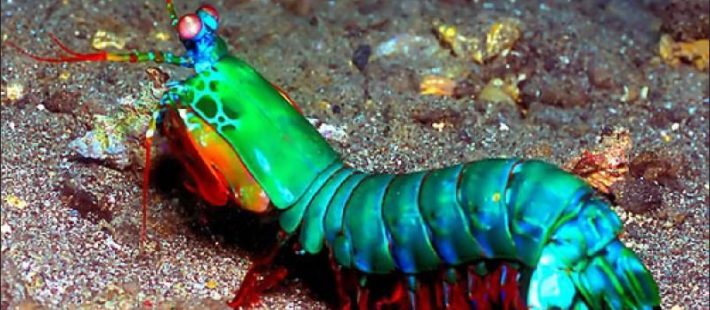
Millions of years ago, the ‘smasher’ mantis shrimp evolved to develop an internal structure to protect the hammer-like club it uses to pulverise prey with incredible speed and force. This unique structure that wraps around the mantis shrimp’s club protects it from self-inflicting damage as it crushes hard-shelled prey.
The University of California Riverside (UCR) has spent over 11 years and over US$ 9 million dollars reverse engineering the club and has determined that it is not the material, but the structure that provides the strength and toughness. The material is organised in sheets of locally parallel fibres that are stacked upon each other such that each sheet is skewed by an angle from the sheet below it. This unique architecture is called a helicoid and has now been broadly patented by UCR and licensed to Helicoid Industries Inc. to commercialise its use in composite materials.
The advantages of using helicoid architecture for composites
Manufacturing ultra-strong composite materials and components using this helicoid structure will result in them being lighter, stronger, tougher, and more impact resistant.
More in general, utilising the helicoid structure instead of traditional fibre alignment for composite product will provide one of two benefits (or a combination of both):
- composite parts will provide similar strength and toughness, but only require approximately half of the material to achieve these properties, resulting in reduced material costs, reduced weight, and better energy efficiency.
- using the same amount of material would result in approximately twice the strength, toughness, and damage resistance which would be preferred in applications where weight reduction is not a driving factor such as armour plating or bullet proof vests. The benefits of the helicoid structure have been demonstrated regardless of the materials used to create the composite material.
This helicoid structure is a platform technology developed by David Kisailus, professor at the University of California, Riverside; this technology can be applied to numerous industries that are constantly searching for lighter and stronger components.
In the mantis shrimp, the helicoid prevents cracks from growing and dissipates significant amounts of energy from strikes to avoid catastrophic failure. It achieves immense impact resistance without adding unnecessary weight. Kisailus and his team discovered manufacturing ultra-strong composites and components using this helicoid structure results in lighter, tougher, and more impact-resistant products.
The industrial applications
Helicoid Industries now would like to sublicense the technology to the sporting goods, wind turbine, aerospace, auto parts, defence, and industrial components industries. The biggest impact of this technology could be felt in wind-turbine manufacturing where the lower energy production costs of larger blades are offset by limitations imposed by their increased weight. Helicoid composite materials would make larger, more lightweight blades and improve the efficiency and cost-effectiveness of wind-based energy production.
Source: Insidecomposites, Helicoid Industries