

Tohoku University’s Graduate School of Engineering, Graduate School of Information Sciences and NEC Corporation are jointly working on a materials integration system that would accelerate the development of carbon fiber reinforced plastics (CFRP) for aircraft.
Japan currently produces a wide range of materials, but which require a lot of time and expense to develop. This new R&D, conducted under the Japanese government’s Cross-ministerial Strategic Innovation Promotion Program (SIP), aims to reduce the cost and time needed to develop composite materials for next-generation aircraft by up to 50 percent.
To achieve this, the team will create an integrated system capable of digitally developing CFRP for aircraft structures using simulation tools developed by Tohoku University, and NEC’s SX-Aurora TSUBASA vector supercomputer.
Specifically, by implementing simulation codes on a supercomputer that can analyze mechanical responses from a molecular level to the aircraft’s wing and fuselage, the processes of material selection and design can be performed at high speed and at multiple scales.
With this system as a common platform, it is expected that tailor-made material development can more effectively meet the demands of airframe manufacturers.
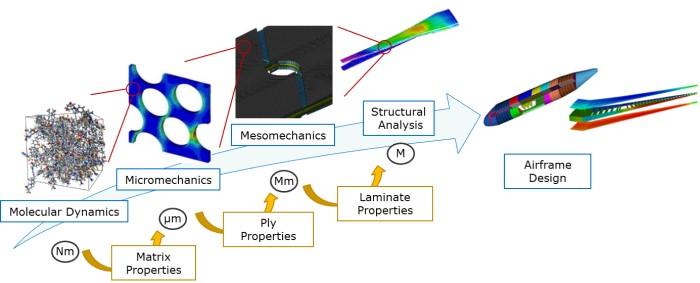
R&D Overview
Development of a multiscale simulation platform (Professor Tomonaga Okabe, Graduate School of Engineering, Tohoku University)
Using the results from scientific research in composite materials, Tohoku University has already developed a variety of simulation tools for CFRP, together with companies participating in Japan’s Cross-ministerial Strategic Innovation Promotion Program. The integrated systems developed in this R&D will be applied to aircraft as well as a wide range of other vehicles in the future.
Application of high performance computing technology (Professor Hiroaki Kobayashi, Graduate School of Information Sciences, Tohoku University)
Simulation programs for materials integration systems will be vectorized and parallelized for the SX-Aurora TSUBASA vector supercomputer to significantly reduce the execution times of the simulation programs. This research emphasizes cooperation with participating companies to accelerate programs.
System construction using supercomputer (NEC)
The SX-Aurora TSUBASA supercomputer consists of vector engines that perform high performance simulation programs and a vector host that performs a wide variety of processes. This R&D utilizes NEC’s supercomputer technologies and system construction know-how to systematize simulation programs with the SX-Aurora TSUBASA supercomputer. The materials integration system will combine both data science and optimal material design.
Source: Tohoku University